Did you know June 3rd is National Egg Day? What better way to celebrate than with an egg shell science experiment that’s as easy to set up as it is fun to observe!

Today, we’re turning a raw egg into a rubbery, bouncy version of itself—no shell required! This simple vinegar experiment is a hands-on way to introduce your kids to chemistry, patience, and a little bit of biology. It’s also a fantastic way to get your kids curious about what’s going on beneath the surface.
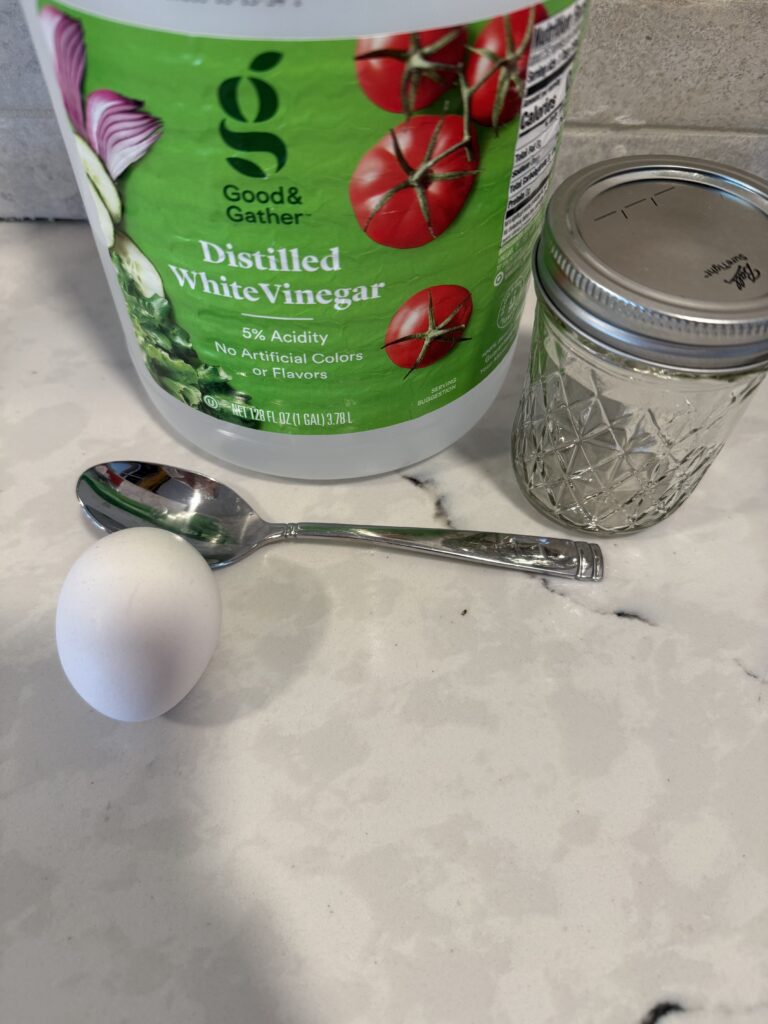
Supplies You’ll Need:
- 1 raw egg
- 1 cup of vinegar (any kind works, but white vinegar gives the clearest results)
- A clear jar or cup
- A plate or small bowl for transferring
- Curious little scientists!
What To Do:
- Carefully place a raw egg into your jar or cup.
- Pour vinegar over the egg until it’s fully submerged.
- Watch what happens—immediate bubbles will start forming on the shell!
- Set the cup aside and let the egg sit for 24 to 48 hours.
- Check on it at the 24-hour mark—gently swirl the cup and notice any changes.
- After 48 hours, carefully remove the egg and rinse it under cool water.
- Gently rub away any remaining shell.
The Science Behind An Egg Shell Science Experiment:
What’s actually happening here?
The eggshell is made of calcium carbonate. When the shell meets the acetic acid in vinegar, a chemical reaction occurs. The acid breaks down the calcium carbonate, releasing carbon dioxide gas—which is why you see all those fizzy bubbles!
Once the shell dissolves, what’s left is the egg’s membrane. This thin but surprisingly strong layer keeps the egg intact, even without the hard outer shell. It’s flexible, slightly translucent, and allows you to see the yolk floating inside. If you give it a gentle squeeze, it feels like a rubbery water balloon!
Learning Opportunities:
- Talk about chemical reactions and acids vs. bases.
- Introduce the concept of osmosis—if you try placing the de-shelled egg in corn syrup or water next, you can explore how liquids move in and out of the egg.
- Discuss how the membrane protects the egg, and compare it to how our skin protects our bodies.
Make It Fun:
Have your kids make predictions—What will happen after 24 hours? Will the egg bounce? Will it break? Use a notebook to log your observations over time. Take pictures to track the transformation and maybe even try out different liquids to see what happens!
Extension Ideas:
- Glow-in-the-dark eggs: Add a drop of highlighter ink to the vinegar and shine a blacklight on it after the shell dissolves.
- Osmosis experiment: Place the egg in corn syrup, saltwater, or plain water after removing the shell and observe how its size changes.
Happy National Egg Day!
Celebrate today by cracking open curiosity! This egg experiment is a perfect way to sneak in a little science, spark conversation, and make learning memorable.
Let us know if you try it—we’d love to see your results! Tag us @brewingcrafts and share your egg-ventures. Want some more fun science experiments? Check out our rain cloud in a jar.

















Comment:
This experiment is a fun and engaging way to teach kids about science. Turning an egg into a bouncy ball with vinegar is both surprising and educational. I love how it encourages kids to make predictions and observe changes over time. Trying different liquids could lead to even more interesting results.
Question: What other liquids could be used in this experiment, and how might they affect the egg differently? WordAiApi